


A Conversation with Brant A. Gardner on Book of Mormon Authenticity
by Jared Riddick
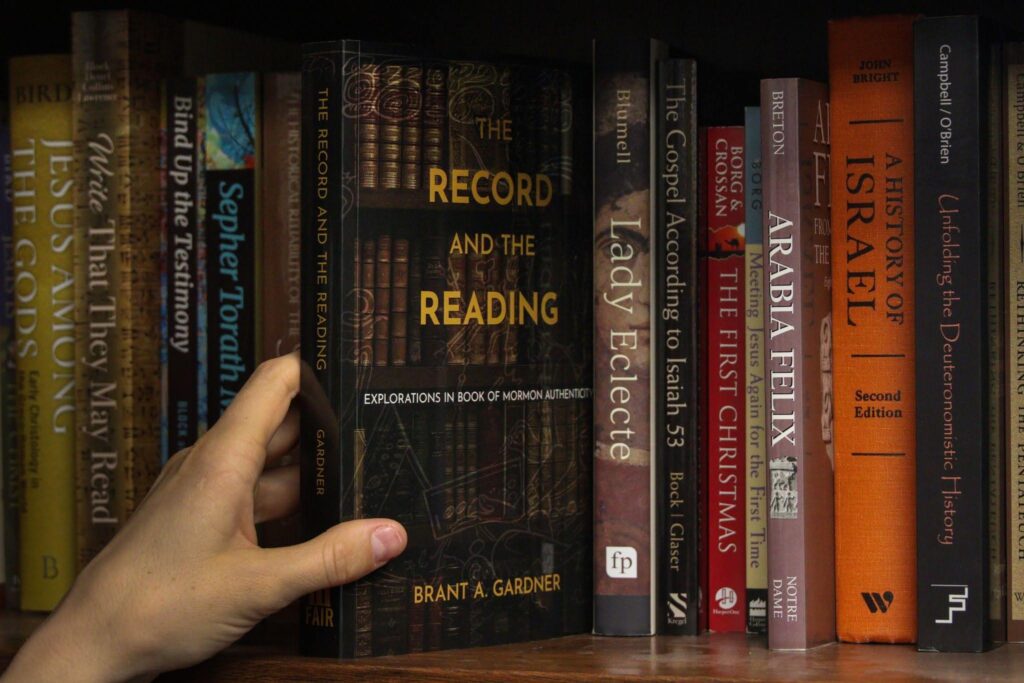
This month has seen the release of two exciting new titles from FAIR Books, our small but growing publishing arm. The Record and the Reading: Explorations in Book of Mormon Authenticity by Brant A. Gardner, is an edited and selected compilation of his presentation from FAIR and other conferences, as well as scholarly articles, that have been published over the past twenty-five years.
Since we conceived of the idea of this book in October of 2025, and got Brant onboard, it has been an absolute pleasure going through these articles, updating and trimming sections where necessary, and getting to work with him more closely. He is an excellent scholar and devoted reader of the Book of Mormon, and those who read this compilation will find themselves tremendously benefitted by the insights and methodology he brings to its study.
As part of our ramp up to publication, we sent him a series of questions to respond to about the book and subjects therein, which we think you will enjoy.
Get your copy on the FAIR Bookstore or on Amazon today!
Question
In the opening section of the book, you tackle some popular but problematic “evidences” for the Book of Mormon, such as the Michigan Relics, the Bat Creek Stone, and the Quetzalcoatl myth. Why is it so vital for defenders of the faith to let go of these well-loved but flawed artifacts, and how does discarding them actually strengthen our foundation?
Response: We believe that the Book of Mormon is true, and we want others to know it is as well. We turn to evidences that might help them believe – or that at least will support our own belief. When we turn to forgeries or wishful readings of history, we build on a sandy foundation. Such things cannot convince others, because they (unlike the Book of Mormon itself) are not true. The danger for believers is that we might eventually learn that these artifacts are fakes or that the stories misread the evidence. A house on sand too easily falls, and these things are sandy foundations at best.
Question
You argue that looking for a single “smoking gun” archaeological proof for the Book of Mormon is the wrong approach. Instead, you advocate for building a “web of interlocking evidence.” Can you explain how this methodology works and why it yields much richer results?
Response: Regardless of what the single thing might be, as an anomaly, it can be dismissed. To be considered a “smoking gun” it really has to be a big gun! Archaeology and historical analysis simply don’t work that way. What it requires is building a consistent case from multiple types of evidence which all converge in a single place at a single time. In the case of the Book of Mormon, those convergences add an additional layer of needing to converge with the Book of Mormon at that same time and place. That is quite difficult, but that is the way good archaeology and history work. Fortunately, the Book of Mormon works better in that more complicated method of connecting it to the real world that it does to producing a “smoking gun.”
Question
You have spent a career situating the Book of Mormon within a Mesoamerican setting. For a reader who might be new to this approach, what is one of the most striking “aha!” moments in the book where ancient Mesoamerican culture perfectly explains a confusing detail in the Nephite record?
Response: How ironic that this question should follow the one above. There isn’t any one thing. There are so many things. There is, however, a category that I can say I find most impressive. I call that category productivity. By that, I mean that the intersection of time and place (Mesoamerica at the appropriate time periods for the Book of Mormon) can enrich and expand our understanding of the Book of Mormon. Little things become “aha” moments. For example, Amulek taught:
For it is expedient that there should be a great and last sacrifice; yea, not a sacrifice of man, neither of beast, neither of any manner of fowl; for it shall not be a human sacrifice; but it must be an infinite and eternal sacrifice. Now there is not any man that can sacrifice his own blood which will atone for the sins of another(Alma 34:10–11).
Why would he add that it should not be a human sacrifice, or that one cannot shed one’s own blood to atone for others? Mesoamerica knows. Human sacrifice was standard. The king would ceremoniously shed his own blood for his people. As one of the small convergences that add up, we not only see why this sentence is there, we have a greater understanding of why it was important to Amulek’s audience.
Question
In your essay on the social history of the early Nephites, you discuss Jacob’s seemingly abrupt condemnations of wealth and polygyny. How does understanding the local trade and economic pressures of ancient Mesoamerica completely reframe what Jacob was dealing with?
Response: Most modern Book of Mormon readers read the text devoid of any historical context. It is simply there – without any actual reason for being there (perhaps other than to teach us something). Just as the Old and New Testaments, the Book of Mormon “grew up” in a time and place, and that time and place influenced the lives of the people who lived — but are rarely mentioned by name — in the Book of Mormon. Understanding history shows how the prophets responded to history and therefore helps us understand how modern prophets might respond to the history happening all around us.
For Jacob, he was not dealing with a few renegade Nephites who somehow decided that costly apparel and polygamy might be fun and they should try it. The Nephites lived in a region and absorbed material and mental culture from the surrounding regions (just as Israel did in their Old World homeland). This process of dealing with the influence of the world around us is clearly a continuing modern issue and we can learn from Jacob’s denunciation of certain parts of it.
Question
A significant portion of this collection explores Mormon not just as a compiler, but as a highly intentional historian and editor. When we start “looking over Mormon’s shoulder,” as you put it, how does it change the way we read the narrative flow of the Book of Mormon?
Response: Mormon was a genius, in my opinion. His masterwork was a synthesis of nearly a thousand years of history into a coherent theological story. It was a story that taught by example and Mormon had to make sure that all the right examples were highlighted. We cannot tell how much he left out, but it had to have been considerable. What he wrote, he crafted. Even when quoting, it was Mormon selecting and contextualizing what he quoted. How does this help us understand his text? It should give us a new perspective. We should move deeper into the text than the simplistic “he wrote what happened.” Mormon didn’t create unhistorical events, but he did mold them so that a much greater lesson was taught — not just in the verses we pull out to quote to each other, but in the reason for the longer arc of connected (and often paralleled) stories he told.
Question
You discuss the interplay between literacy and orality in Nephite culture. We often think of the Nephites solely as a literate people because of the gold plates, but how did their reliance on oral tradition shape the way sermons and histories were actually delivered and preserved?
Response: We moderns have a difficulty understanding a world where there was significantly less literacy than we experience. We do hear that there are those among us who are termed “functionally illiterate,” and it comes as a shock and surprise. We read our world back into the Book of Mormon and therefore expect our level of literacy when “functionally illiterate” might have been a generous assessment for most.
What the Book of Mormon represents is a culture with incipient literacy. There were literate elite who could read and write. As with other cultures at that stage of development, elite literacy did not replace concepts of orality, even in their writing. For the Book of Mormon, we can follow some of their arguments and note that they still employ techniques from oral discourse. They use parallelism as an important tool. In an oral culture, repeating something gave the listeners another chance to understand it. Artistic parallelism repeated the ideas with different words, which also enhanced understanding. When we see Nephi or Moroni complaining that they are better at speaking than writing, we are seeing artifacts of their participation in that oral literary world which has not gone away — even though they are writing.
Question
Your chapters on the translation process delve into Joseph Smith’s use of seer stones and introduce the concept of “mentalese” (the brain’s pre-language). How does viewing the translation through the lens of cognitive linguistics help us understand the presence of King James phrasing and other unique linguistic features in the text?
Response: The included chapters don’t directly address the recent emphasis on Early Modern English as the language of the Book of Mormon, and I can’t do that here in this response. I will note that even in that hypothesis, a translator is required and that translator produced a text that includes language and references to New Testament phrases from the King James Bible that could not have been part of whatever language was on the plates. In other words, even though I disagree with removing Joseph Smith as the actual translator, the problem of the text we read is essentially the same. It includes language that could not have been a word for word translation of the plates. This is the reason that Royal Skousen has called the Book of Mormon a “cultural” translation. The translator’s mind was present.
The idea of mentalese is, I believe, a consistent model for how a text in any source language becomes the translated text in the target language. A mind is involved. When that mind is involved, the culture and vocabulary of that person provides the contexts in which the translation occurs. This means that even with divine assistance, the plate text was translated into language and idioms from Joseph Smith’s time. Similarly, even if there was a much better word to use in the translation, but it hadn’t entered English by Joseph Smith’s time, divine assistance didn’t presciently add that word.
Question
Some people are troubled by the idea of Joseph Smith using a seer stone in a hat to translate. How does your historical and cognitive analysis in the book help demystify this process and reaffirm the claim that it was done by the gift and power of God?
Response: I accept that Joseph used the interpreters and later a seer stone. What both of those instruments have in common is that they are stones – rocks. They also have in common the fact that not everyone who uses them can see anything. My mobile phone is a modern miracle, and it shows me all kinds of wonders. I can have someone else look at the screen and share those wonders with them. The interpreters and seer stones didn’t work that way. Only some had the talent to use them, and those who did could actually see in them. Others in Joseph Smith’s community could also use seer stones, and those people and Joseph used them to “see” hidden things – often things which were lost.
God used Joseph’s understanding to shift his talent from seeing lost things in the seer stones to seeing a lost language and a lost text. The similarity of the medium helped Joseph have the confidence to engage with God in the task, but God and Joseph translated – not the stones.
Question
If a reader wants to truly understand the Book of Mormon on its own ancient terms, which specific essay in this collection do you think will challenge and expand their perspective the most?
Response: Probably “As Social History of the Early Nephites,” gives a good introduction in the concepts behind the way I place the Book of Mormon in Mesoamerica and provides examples. Other chapters delve deeper, but this would probably be the best first article for that purpose.
Question
You mention that after forty years of intense study, your curiosity about the text remains unquenchable. What is it about the Book of Mormon that continues to yield new insights after all this time?
Response: One could spend much of a lifetime attempting to learn the life principles in the Book of Mormon. It only becomes more complex and richer when one dives deeply into the writers and what — and why — they wrote. Nephi was a wonderful writer, Mormon was a wonderful writer, but the two are very distinct and write for very different reasons and therefore they can speak of similar things with very different meanings. My main example is how Nephi and Mormon see the Lamanites. Nephi is writing at a time when he must establish a new city-nation. One of the ways of doing this was to establish the unity of “us” against those who are not “us.” The use of this “us/then” dichotomy is well understood and Nephi is an excellent example. The Lamanites are the enemy. Modern readers tend to see them that way throughout the Book of Mormon because we read Nephi first.
Mormon’s Lamanites are different. They are not “us,” but they are no longer the targeted enemy. In Mormon, the “bad guys” are apostate Nephites who stir up the Lamanites. Then it is the Gadiantons who cause trouble. Mormon even lays the destruction of the Nephites at the feet of the Gadiantons. Why not the Lamanites? When Mormon is writing, he is writing to the Lamanites to tell them they are of the House of Israel – that they can repent. The Anti-Nephi-Lehies, the Lamanites later converted by Nephi and his brother Nephi, and Samuel the Lamanite are all specifically selected to show that Lamanites can repent – and that repentant Lamanites might even exceed the Nephites in righteousness. That is very different from the Lamanites in the small plates.

There is so much more. I read books about the Old Testament and see new ways to understand the Book of Mormon. Scholarly books on the New Testament similarly open new perspectives. The more I learn, the more there is to know.
This book is the first of several similar compilation volumes that we would like to do, featuring some of FAIR’s frequent conference speakers over the years. Who would you be interested in seeing? Leave us some suggestions in the comments below.
We mentioned that The Record and the Reading was one of two titles published by FAIR Books this month. The other is A New Translation of Isaiah: Based on Ancient Scrolls and Texts, translated and edited by Donald W. Parry. There will be another Questions & Response post featuring it, coming soon.
Stay tuned! And Happy Reading!
 Brant Gardner is an anthropologist and author specializing in Mesoamerican context and Book of Mormon studies. He will be speaking at the 2026 FAIR Conference.
 Jared Riddick is the Managing Editor for FAIR. From 2015 to 2025, he was the research librarian and archivist for Scripture Central, where he established, built, and curated their digital library of over 14,000 items. He graduated from the University of North Texas with a Masters in Library Science with two graduate academic certificates in Archival Management and Digital Curation and Data Management. He received a Bachelor of Arts in History Education from Brigham Young University-Idaho. He was also an editorial consultant for Interpreter: A Journal of Latter-day Saint Faith Scholarship from 2012 to 2017.
The post Beyond the Sandy Foundation appeared first on FAIR.
Continue reading at the original source →