


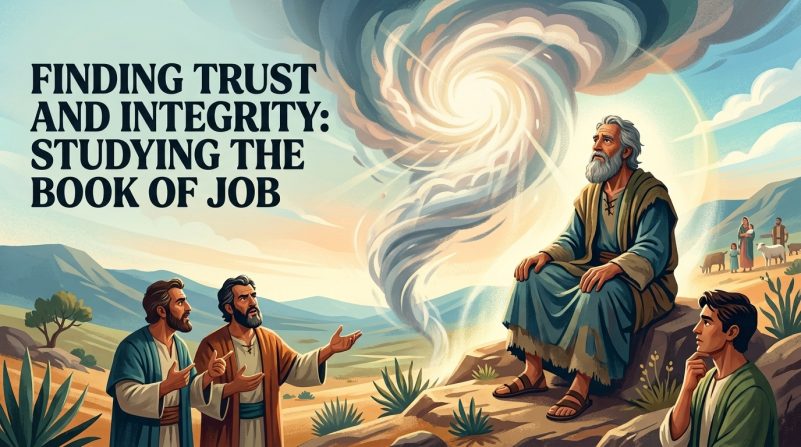
In our Come, Follow Me study, we have just read the book of Job in the Old Testament. It addresses one of life’s most enduring questions: Why do good people suffer?
Summary of The Book of Job
Most of the book is written in poetic form, with a prologue and an epilogue in prose
The Heavenly Discussion (Chapters 1–2)
Job is described as a righteous, wealthy, and blameless man. Satan (the Adversary) claims that Job only serves God because he is blessed. God allows Satan to test Job by stripping away his wealth, children, and health. Through all this, Job remains faithful and refuses to curse God.
Note that the conversations between God and Satan likely do not describe an actual interaction between them. These conversations are best understood as a poetic way of conveying Satan’s role as our adversary. The Hebrew word translated as “Satan” means “adversary” or “accuser.” When reading this account, remember that God has power over Satan. God only does what is for the benefit of His children.
The Dialogues with Friends (Chapters 3–31)
Three of Job’s friends (Eliphaz, Bildad, and Zophar) comfort him, but they quickly accuse him of secret sins. Their traditional worldview is that God rewards the good and punishes the bad. Therefore, they reason that Job must deserve his suffering. Job defends his innocence, rejecting their transactional view of God’s justice.
The Speech of Elihu (Chapters 32–37)
A younger observer named Elihu intervenes. He criticizes both Job for asserting his righteousness and the friends for failing to explain Job’s suffering, arguing that suffering can be corrective rather than punitive.
God’s Answer from the Whirlwind (Chapters 38–41)
God speaks to Job directly, taking him on a tour of the cosmos, wild animals, and terrifying beasts. Instead of giving Job a reason for his suffering, God asks a series of rhetorical questions highlighting the vastness, complexity, and mystery of the universe compared to human understanding.
Restoration (Chapter 42)
Job humbles himself, acknowledging God’s ultimate sovereignty. God rebukes the three friends for speaking falsely about Him, whereas Job spoke honestly. God restores Job’s health, doubles his former wealth, and gives him a new family, allowing Job to live a long, full life.
Core Themes
- All suffering is not divine punishment. As humans, we don’t understand the full complexity of God’s divine wisdom. The book of Job clarifies that having afflictions does not necessarily mean that a person has sinned. The Lord may use affliction for experience, discipline, and instruction as well as for punishment (D&C 122).
- God accepts our honest questioning of our faith. It’s natural to wonder why bad things happen to good people or why good things happen to bad people. Why would God, who is just, allow that? The book of Job explores questions like these. Job was one of those good people to whom a lot of bad things happened. Because of Job’s trials, his friends wondered if he really was good after all. Job asserted his own righteousness and wondered if God really is just. But despite his suffering and wondering, Job maintained his integrity and faith in Jesus Christ.
In the book of Job, faith is questioned and tested. That doesn’t mean all the questions are answered. But the book of Job teaches that until they are answered, questions can coexist with faith. And regardless of what happens in the meantime, we can say of our Lord, “Yet will I trust in him” (Job 13:15).
For a more in-depth study of this topic, download the free booklet Learning Through Life’s Trials.

The post Book of Job Teaches Us That Challenges Are For Our Experience first appeared on LDS365: Resources from the Church & Latter-day Saints worldwide.
Continue reading at the original source →