


 Download Print-Friendly Version
Note: This piece is the third in a three-part series that reviews the best available science on the connections between religiosity and health. Part 1 discusses mental health; Part 2 discusses physical health; and Part 3 discusses social-relational health.
What does the best science reveal about whether religion helps or harms us? Today, we turn to a focus on religion’s connection to relationships, including marriage and community ties.
Medicine and social science recently reached a landmark with the publication of “The Handbook of Religion and Health,” a Duke and Harvard University collaboration. Described as “stunningly ambitious” by former U.S. Assistant Secretary for Health Howard Koh, the text included only the most rigorous 5% of studies conducted on religion and health (about 2,800 out of 60,000).
What the Best Science Reveals about the Religion-Social Health Connection
Following the lead of the Duke-Harvard team, our BYU-Duke team divided the best studies into four different domain involving the religion-social health connection:
- Delinquency and Crime
- Social Support
- Marital and Family Stability
- Substance Abuse and Addiction
A fifth domain, Fertility, is addressed at length in the full-length Religion and Social Health report but is not addressed in the present article. Each scientific study that made the cut for rigor (i.e., the top 5%) was examined by the Duke-Harvard team to see if the core findings indicated:
(1) a positive connection between higher religiosity/religious involvement and improved social health;
(2) a negative connection that showed that higher religiosity/religious involvement was connected with decreased social health; or
(3) findings that were mixed or complex.
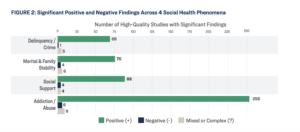
Of the studies that met the Handbook authors’ stringent inclusion criteria, 528 high-quality studies reported significant findings regarding religion and social health. Of these, 489 (93%) identified positive associations, 15 (3%) reported negative associations such as unhealthy religious influences, and 24 (about 4%) yielded mixed or complex results. Taken together, the best available evidence indicates that religion is far more often associated with beneficial social and relational outcomes than harmful ones, with positive findings outnumbering negative findings by almost 33:1. Across the four social health domains, here is a visual breakdown of studies:
We now take a brief but closer look across the domains of social health.
Religion, Delinquency, and Crime: Of the most rigorous studies examining religion in relation to delinquency and crime, 69 found that higher religiosity was associated with lower rates of delinquent and criminal behavior. Only one study reported a negative association, yielding a positive-to-negative ratio of 69:1. Together, these findings suggest that religion is among the most consistently protective factors identified in the social science literature on crime. This is vitally important given that varying estimates for the overall costs of crime in the United States across local, state, and federal levels range from $690 billion to a staggering $3.4 trillion.
Religion and Social Support: Of the 96 high-quality studies examining the relationship between religion and social support, 88 (approximately 92%) found that religiosity was associated with higher levels of social support and increased prosocial activity, including altruism, generosity, volunteering, and charitable giving. Only four studies (approximately 4%) reported negative associations, yielding a positive-to-negative ratio of approximately 22:1. Further, Gallup World Poll data similarly indicate that religious attenders are nearly twice as likely as nonattenders to volunteer their time in a given month (57% versus 31%). Thus, religious participation is associated not only with greater social support (and mental health and physical health) for religious individuals themselves, but also with increased contributions of time and resources that benefit broader society, including both religious and nonreligious communities.
Marital support during challenges can help protect against divorce.
Religion and Marital & Family Stability: Of the most recent studies on the link between religion and marital and family stability, 76 studies (88%) found that higher levels of religiosity were associated with greater marital and family stability and/or higher relationship satisfaction. Four studies (less than 5%) reported negative findings, a 19:1 positive-to-negative ratio. Many faith communities provide structured forms of support, including marital education, counseling, and peer support groups. In addition, faith-based welfare and assistance programs often function as informal safety nets, offering material, emotional, and social support during periods of heightened stress, such as job loss, serious illness, injury, family bereavement, or natural disasters. Multifaceted marital support during challenges can help protect against divorce.
Religion, Substance Abuse, and Addiction: From the 271 highest-quality studies on the religion and substance abuse connection that reported significant findings, 256 studies (94%) found that religion correlated with lower rates of substance abuse and addiction. Only six studies (2.2%) found religion to be correlated with higher rates of substance abuse, a 43:1 positive-to-negative ratio. Given the extensive and far-reaching harms caused by substance abuse and addiction, a substantial body of research has focused on identifying effective strategies for prevention and rehabilitation. A significant point of consideration is that religion has been repeatedly identified as both a leading preventative force for many, as well as a rehabilitative help for some. Additionally, lower rates of alcohol and drug abuse among the more religious also contribute to lower rates of mental illness as well as several physical health concerns and phenomena, including cigarette smoking, heart disease, and cancer, among many others.
The Threshold Effect: How Much Religion Does It Take?
Higher levels of religious involvement are strongly associated with better mental health, including more robust coping with stress, lower rates of depression and anxiety, fewer personality disorders, and far lower levels of suicide and suicidal ideation. Higher religious involvement is also linked to better physical health, including significantly lower rates of cigarette smoking and cancer; reduced obesity, heart disease, hypertension, cerebrovascular disease, Alzheimer’s disease, and chronic pain; healthier patterns of exercise, physical activity, diet, and immune function; and ultimately longer life. It is vital to note that the best science reveals a threshold effect: the benefits of religion are strongest among those with high and sustained levels of belief and engagement. Specifically, across ages and faith traditions, the greatest benefits are seen among the faithful who attend religious services weekly or more.
These social benefits extend beyond the individual.
In the domain of social health, the imbalance between positive and negative findings in the most rigorous studies is especially striking. For delinquency and crime, the imbalance is 69 to 1; for marital and family stability, it is 76 to 4 (a 19:1 ratio); for social support, 88 positive studies to 4 negative (a 22:1 ratio); and for substance abuse and addiction, 256 positive studies to 6 negative (a 43:1 ratio). Together, these patterns help explain why a leading sociologist of religion of the past half-century subtitled one of his final books How Religion Benefits Everyone, Including Atheists.
From a health-promotion perspective, this growing body of evidence offers potent, science-based support for active religious involvement, with wide-ranging mental, physical, and social benefits that extend beyond individuals to families, communities, and society at large.
Our team’s invitation is two-fold: (1) On a personal level, may we each diligently live our faith beyond a “threshold level” where the faith factor thrives; and (2) On a public level, may we support policies and practices that protect religious liberty and encourage people to live their faith in ways that benefit their lives and improve their mental, physical, relational, and social health.
The post The Social Health Case for Religion appeared first on Public Square Magazine.
Continue reading at the original source →